

Organic growth problems are often treated as content problems. Traffic slows, so publishing increases. More landing pages get added, more blog topics get written, and the content calendar grows.
For an Indian solar company working with Ritik Namdev of theStacc, that is exactly what was happening. The team was publishing content consistently, Google was showing those pages thousands of times a day, and several were reaching page one.
None of that was turning into real traffic growth.
When the project started on March 30, 2026, the website got 53 organic clicks and 6,131 impressions a day. Through April and May, while publishing kept going, clicks averaged just 84 a day. Plenty of pages were showing up in Google, but they were stuck around position 7 to 9.
The team decided that publishing more content on top of a broken website would just scale the same problem.
So they spent seven weeks rebuilding the site’s foundation: URL structure, duplicate pages, redirects, templates, internal linking, and how easily Google could crawl it. The rebuilt site went live on June 5.
By June 7, Search Console showed 346 clicks a day. By June 10, it was 531. The site kept climbing from there, eventually hitting a best day of 1,037 clicks and 92,029 impressions.
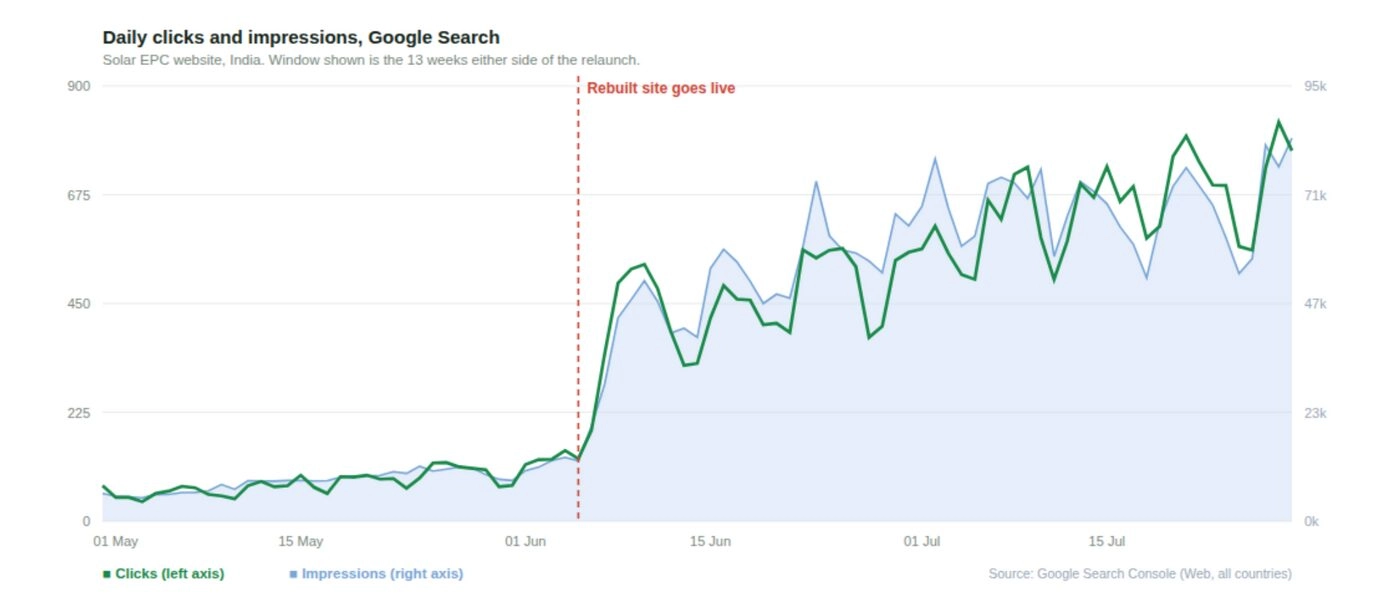
Daily clicks, before and after the rebuild
Source: Google Search Console, shared by Ritik Namdev / theStacc.
At first glance, this looks like a simple technical SEO win.
The full picture is more useful than that headline. A big content push happened at the same time as the rebuild, so the two changes overlap and can’t be fully separated. Instead of weakening the case, that overlap actually shows something useful: how technical work and content work depend on each other when a business tries to grow organic traffic.
Google could see the pages. Rankings still weren’t moving.
The client designs and installs rooftop solar systems for homes and businesses across India.
Search plays a real role in that buying journey. People research government subsidies, financing, equipment, and panel brands long before they ask for a quote. The content strategy was built to capture that research stage, before the quote request.
By April, the company already knew Google understood most of its content. The site was getting 6,000 to 9,000 impressions a day, but many pages were stuck around position 7 to 9. More publishing was only producing slow click growth on top of that.
That distinction mattered for the diagnosis. A site with almost no impressions has one kind of growth problem. A site with thousands of impressions that keeps stalling near the bottom of page one has a different one entirely.
Ritik’s team looked into the second problem.
A full site crawl turned up 1,521 issues. Among them: 993 pages sending Google conflicting signals about which version of a page was the real one, 475 internal links routing through a redirect instead of going straight to the page, and 357 dead links returning “not found.” Search Console was also showing the same article twice, once under each version of the domain.
The issues went beyond a raw error count. Web addresses had drifted over the years. Some URLs still carried a year that had to be edited every time an article got updated. One important page had a spelling mistake baked into its URL, and Google had indexed the misspelled version. Slash and non-slash versions of the same pages existed side by side, competing against each other in search. Both the www and non-www versions of the domain were live and indexed at the same time.
None of this was really about tidiness. The company planned to publish a lot more content, and on the existing setup, every new batch of articles risked copying the same structural problems across an even bigger site. Ritik describes this as the moment the project stopped being about improving content and became about rebuilding the system underneath it.
The rebuild fixed the site, not the platform
The site ran on WordPress, and this case isn’t an argument against WordPress. Ritik is careful to separate the CMS from the problem: what he diagnosed was specific to this install, after years of plugins, theme changes, and inconsistent publishing habits.
The rebuild fixed the structural issues the audit had found. One version of the domain became the only official one. URL formatting was standardized, and years were removed from article addresses. Six page types, covering things like articles, glossary terms, and city pages, each got one template controlling headings, breadcrumbs, and page settings.
- 265 redirect rules, covering every changed address in both slash and non-slash form, plus old article URLs and the misspelled one
- 9,723 internal links checked in a later audit, with zero broken links found
- 89% cut in total image weight
- 707 pages later rated “Good” for page experience in Search Console
Migration planning was built into the development work itself, not added on afterward. Pages that had been competing for the same searches were merged into one page instead of migrated separately, and every existing article kept its original publish date.
These are real improvements. The evidence further down helps separate the cleanup that was simply necessary from the changes most closely tied to the actual growth.
Launching new URLs usually costs you traffic. This time it didn’t.
The rebuilt site went live on June 5. Changing a large number of web addresses is usually the riskiest moment in a project like this. It’s common to see a temporary dip in traffic right after a migration, while Google re-crawls and re-indexes the new URLs.
That’s not what happened here. The site got 129 clicks on launch day, 188 the next day, and 346 by June 7. By June 10, daily clicks had reached 531, and the climb kept going from there, as the chart above shows.
Ritik credits the smooth migration to decisions made before launch: redirects were already in place on day one, existing content kept its original publish dates, and the migration landed the same week as a large batch of new content, which gave Google a strong reason to re-crawl the whole site quickly.
I don’t think that is normal, and I would not promise it to anyone. Getting a quick re-crawl to happen, with correct redirects already in place, seems to be the whole trick.
He’s also careful not to present this as a general guarantee. This case shows what happened during one migration, not a promise about migration risk in general.
What grew, and by how much
Clicks were only one part of the change. Here’s the headline shift, from the day the project started to the best day recorded since:
Semrush’s independent tracking tells the same story from a different angle. The site’s ranking footprint grew to more than 5,000 organic keywords, with a growing share reaching the top three positions, up from close to nothing before June. Authority Score rose to 28, referring domains reached 274, and backlinks reached 2,800, all without a link-building campaign.
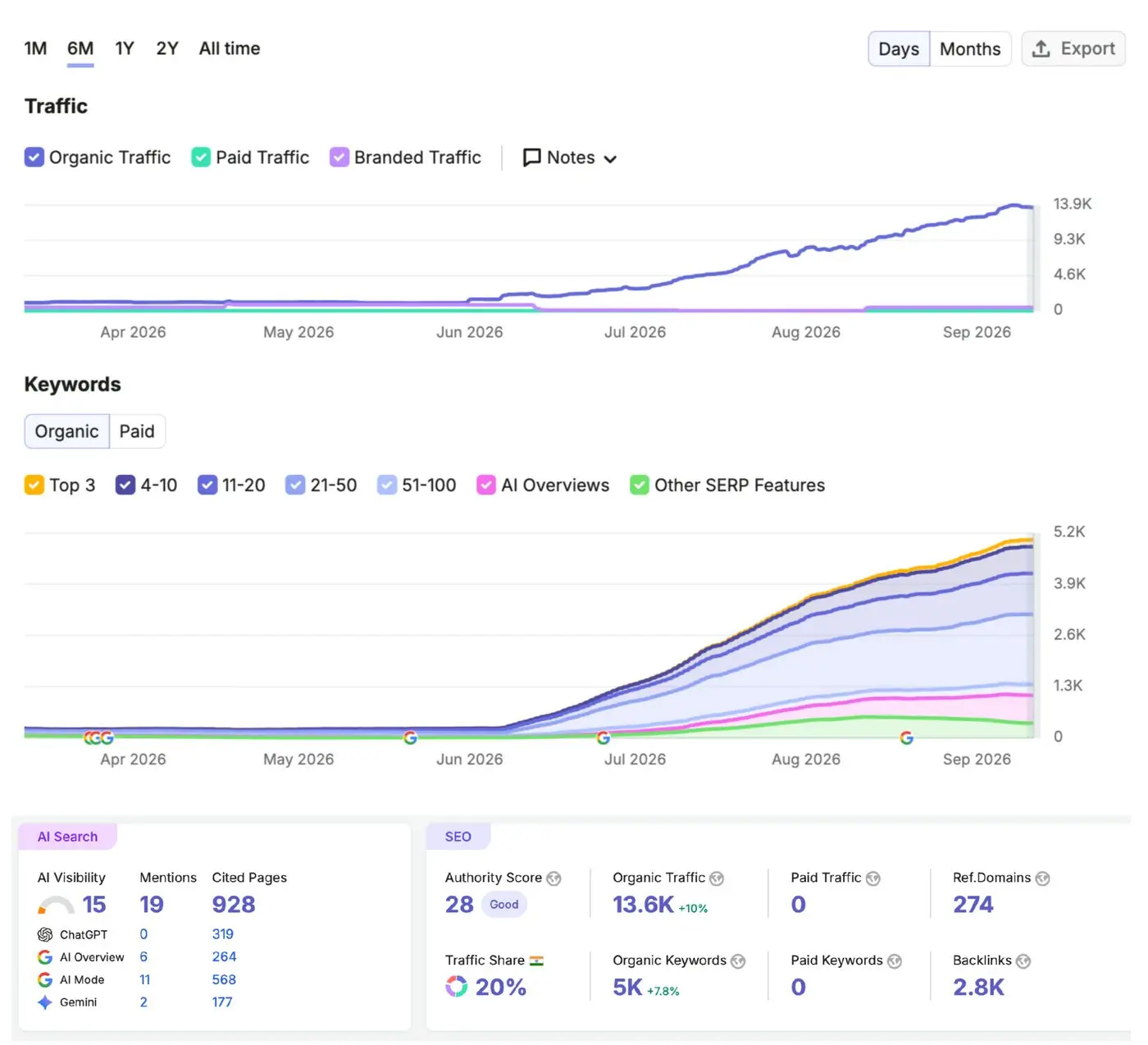
The same Semrush data shows zero paid traffic and zero paid keywords across the period. Ritik says there was no paid advertising, PR push, or deliberate link-building campaign running at any point.
Put together, these numbers show something bigger than a short-lived bump in clicks to a handful of pages. More pages entered search, the number of ranking keywords expanded, and average position across the site moved up.
Content and technical SEO were working together, not against each other
Crediting all of this growth to the rebuild alone would claim more than the evidence supports. A large content push happened around launch: 161 glossary pages, then 100 new articles, then another 55 about a week later.
The rebuild and the content cannot be separated.
That might be the single most useful sentence in this case.
The months before the rebuild give an imperfect but useful comparison. Content kept publishing through April and May, and average daily clicks reached 84. After the rebuild, a much bigger content push landed on a site with different URL handling, templates, internal linking, and crawlability. Traffic then jumped.
The data can’t separate the individual effect of the rebuild from the individual effect of publishing 316 more pages. But it does support a clearer business conclusion.
The company needed both. Content gave Google more pages that could match real search demand. The rebuild fixed the infrastructure those pages were published into, linked from, crawled, and kept consistent over time.
Ritik reports that new articles used to settle around position 8, and after the rebuild, new pages were landing closer to position 5, without any real change to how the content itself was written in June.
For anyone weighing a big content investment, that’s the key point. The return on new content depends partly on the system it’s being added to. If the site underneath has duplicate pages, unstable URLs, inconsistent templates, and weak internal linking, publishing more content also means publishing more exposure to those same weaknesses.
Technical SEO here wasn’t a separate line item competing with content for budget. It was the infrastructure the content depended on.
What this means for your roadmap
Not every fix in this project mattered equally, and that’s worth remembering before copying this playbook wholesale.
-
Structured data helped, but wasn’t the lever
Structured data was added across the site, and it’s worth doing since it costs little. Ritik reports it produced about 60 clicks over three months out of more than 33,000 total. It wasn’t what drove this growth.
-
Speed fixes were worth doing, but weren’t the main driver either
Cutting image weight by 89% was a real improvement, and 707 pages now carry a “Good” page-experience rating in Search Console. It also briefly broke the homepage’s main photos during testing, caught before launch. Ritik’s own read is that the ranking gains line up much more closely with the URL and duplication fixes than with page speed.
-
Look for the constraint that’s limiting your next content investment
For anyone running a similar audit, the useful question isn’t which fixes look most impressive on a checklist. It’s which technical problem is holding back the return on the content you’re already planning to publish.
-
The project still isn’t finished
A later review found that roughly one in five of the site’s top Search Console pages still resolves to the old version of the domain, still picking up impressions that should be consolidating onto the current URLs. Reaching 1,037 clicks a day didn’t require a perfect technical audit, just fixing the problems most likely to get worse as the site grew.
-
Ask these three questions before your next content push
Is existing content underperforming because of weak demand, or is there already real visibility without matching rank progress? Which structural problems get bigger as your page count grows? And will the next hundred pages expand your site’s search footprint, or mostly repeat the technical debt that’s already there?
The most transferable part of this case isn’t the migration technique or the 1,037-click peak. It’s the order of the decision. The company was already investing in content, Search Console showed Google was finding and displaying the pages, and growth stayed modest anyway. A technical audit then found structural problems that would only get more expensive to carry as publishing scaled up, and the team fixed those problems before expanding the content program further.
The headline numbers are real: 53 to 1,037 daily clicks, 6,131 to 92,029 daily impressions at best. Crediting them solely to the rebuild would make this case less useful than the evidence actually supports. What changed is that two things moved together: the amount of content went up a lot, and the infrastructure carrying that content got cleaner at the same time. The data can’t separate how much of the growth belongs to each move individually. It does show that publishing on the old system had produced limited growth for two straight months, and that a cleaner technical foundation paired with a much bigger content push lined up with growth across clicks, impressions, ranking keywords, indexed pages, and average position, all at once.
Before you increase your content investment, it’s worth checking whether the website underneath can actually turn more pages into search visibility. Sometimes the real decision isn’t content versus technical SEO. It’s whether your technical foundation is ready for the content investment you’re already planning.